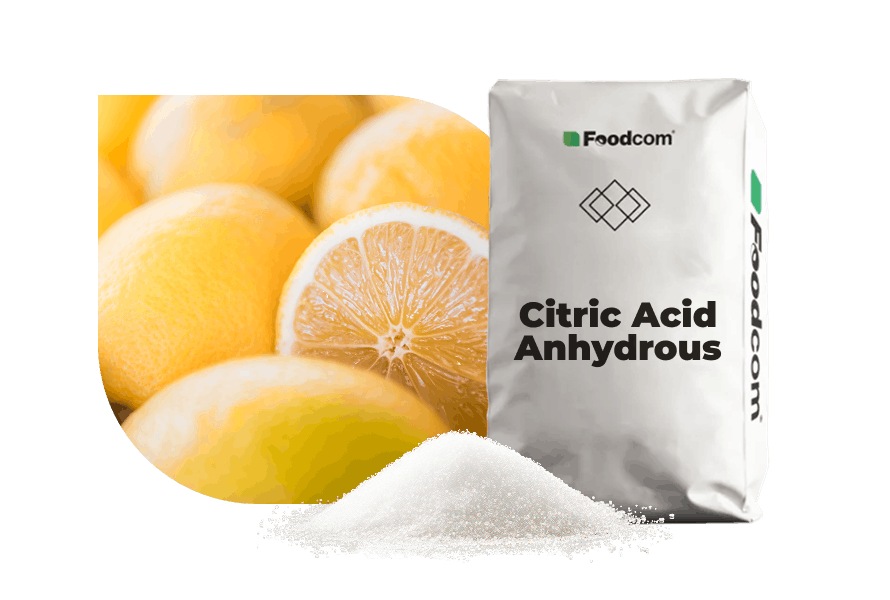
E330 food-grade citric acid anhydrous from audited EU supply chain. No framework contracts, no minimum annual volumes. Certificate of Analysis with every batch. 27 EU member states, DSV road freight.
Citric acid anhydrous (E330, CAS 77-92-9) is a triprotic weak acid produced predominantly by fermentation of carbohydrate substrates using Aspergillus niger. With annual global production exceeding 2 million tonnes, it is the most widely used acidulant in the food and beverage industry. FDCM stocks food-grade citric acid anhydrous from EU-audited producers and supplies B2B buyers across Europe from a single 25 kg bag upwards.
The anhydrous form contains no water of crystallisation, giving a higher active content per kilogram than the monohydrate grade. It is preferred in applications where moisture uptake during storage is a concern, in dry blends and powdered formulations, and where precise acid dosing by mass is required. The product complies with Regulation (EU) No 231/2012 purity specifications and is authorised without quantitative restriction (quantum satis) in the majority of EU food categories under Regulation (EC) No 1333/2008.
FDCM supplies to manufacturers, formulators and trading companies across all 27 EU member states. Orders from 25 kg dispatch within standard lead times via DSV road freight. No annual purchase commitments, no onboarding fees, no minimum basket requirements beyond the per-line minimum of 25 kg.
Full analytical specification for food-grade citric acid anhydrous (E330), compliant with EU 231/2012 and suitable for food, beverage, pharmaceutical and industrial applications.
| CAS / EINECS | 77-92-9 / 201-069-1 |
| E Number | E330 |
| Assay (anhydrous basis) | ≥99.5% |
| Water content (Karl Fischer) | ≤0.5% |
| Sulfated ash | ≤0.05% |
| Oxalic acid | ≤100 ppm |
| Sulfate | ≤150 ppm |
| Heavy metals (as Pb) | ≤10 ppm |
| Lead | ≤1 ppm |
| Arsenic | ≤1 ppm |
| pH (1% aqueous solution) | 2.0–2.2 |
| Appearance | White crystalline powder, odourless |
| Molecular formula | C₆H₈O₇ |
| Molecular weight | 192.12 g/mol |
| Melting point | 153–159°C (decomposes) |
| Solubility in water | 59.2 g/100 ml at 20°C |
| Bulk density | 800–900 g/L |
| Packaging | 25 kg paper bag with PE inner liner |
| Pallet qty | 500 kg (20 bags) |
| Storage | Cool, dry, <25°C — away from strong oxidisers |
| Shelf life | 36 months from production date |
| Microbiological | Per EU 231/2012 — TPC, Enterobacteriaceae, Salmonella |
E330 is the go-to acidulant across beverages, confectionery, dairy, pharma and home care. Here is where it actually works.
Citric acid sets the pH profile of carbonated soft drinks, energy drinks, fruit-flavoured waters and sports beverages. It sharpens perceived freshness, stabilises natural colours (anthocyanins, betacyanins) and extends shelf life by suppressing enzymatic activity. Typical use rate: 1–3 g/L in RTD beverages.
Acid-panning with citric acid and sugar produces the characteristic sour shell on hard candies and gummies. In pectin-based jellies, citric acid lowers pH to the gelation range (pH 3.0–3.5) and activates the pectin network. Also used to adjust pH in gelatine-based products for improved set.
Citric acid is used in fresh cheese and mozzarella production as a rapid acidulant to lower pH and induce curd formation, as an alternative to bacterial starter cultures for faster processing. Also used in processed cheese formulations and as a flavour brightener in dairy-based sauces and dressings.
In effervescent tablets and granules, citric acid reacts with sodium or potassium bicarbonate to produce CO₂ on dissolution — the standard effervescent couple. Acts as a pH-lowering agent in liquid oral dosage forms and parenteral solutions. Ph. Eur. grade available on request.
Citric acid sequesters divalent metal ions (Ca²⁺, Mg²⁺, Fe²⁺) at chelation ratios of approximately 1:1 molar (citric acid to calcium). This property drives its use in descaling formulations, automatic dishwasher detergents (replacing phosphates), laundry products and industrial CIP cleaning agents. Biodegradable and safe versus strong mineral acids.
Used as a buffer component in microbial fermentation media (citrate buffer, pH 3.0–6.2 range). Also applied in downstream processing as a chelating agent for metal removal, and in food-contact equipment sanitisation formulations where its GRAS status and biodegradability are advantageous.
Citric acid (E330) is authorised as a food additive in the EU under Regulation (EC) No 1333/2008. In most food categories, it is permitted at quantum satis — the operator determines the quantity needed to achieve the intended technological effect, with no prescribed upper limit. Purity criteria are set by Commission Regulation (EU) No 231/2012, covering assay, water content, sulfated ash, heavy metals and microbiological parameters.
Citric acid is not subject to carry-over restrictions under Annex III of 1333/2008. It is not classified as an allergen under Regulation (EU) No 1169/2011 and requires no allergen declaration in finished product labelling.
Standard shipment documentation includes a Certificate of Analysis (CoA) per production batch, covering all parameters required by EU 231/2012. On request at no additional cost: Technical Data Sheet (TDS), Safety Data Sheet (SDS, GHS format), allergen declaration, non-GMO statement, country of origin certificate.
For pharmaceutical applications: Ph. Eur.-compliant citric acid with GMP batch release documentation is available on request. Halal and Kosher certificates available for eligible batches — please specify at time of order.
FDCM supplies food ingredient manufacturers, beverage producers and trading companies across the EU. No framework contracts, no minimum annual commitments. Order what you need, when you need it.
Single-bag orders accepted. No annual volume commitments, no framework contract requirements. Scale up to pallet or container quantities at any point.
DSV road freight network. All 27 EU member states, tracked shipments, standard transit 3–7 business days. Temperature-sensitive routing available on request.
CoA per batch as standard. TDS, SDS, allergen declaration, non-GMO statement, Halal/Kosher on request — all at no extra charge.
EU-registered producers, lot-traceable batches. Compliance with Regulation (EC) 1333/2008 and (EU) 231/2012 confirmed by third-party CoA.
Live stock availability, current pricing and full batch documentation on FDCM.eu. Orders from 25 kg, no framework contract required.
Order on FDCM.eu → Browse Full Catalogue